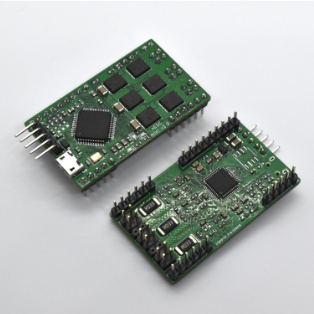
The xESC Mini (xESC2 mini) is a brushless motor controller designed from the ground up for robotics. It came out of a very concrete need: OpenMower needed a small, dependable, affordable way to drive its brushless drive and cutter motors — a full VESC was too big, too expensive, and higher power than a robot needs.
Why it’s a good fit for robots
- Small — a fraction of the size of a VESC, at 50 × 30 mm.
- Cheap — far lower cost than a comparable VESC.
- Right-sized power — plenty to drive robots, without the bulk of a high-power ESC.
- Easy to integrate — pin headers drop it straight into a host board.
- VESC-based firmware — built on the open-source VESC project, so it inherits mature tooling and a large community. A dedicated ROS driver is available too.
Specifications
| Max continuous current | 10 A |
| Max voltage | 40 V |
| Size | 50 × 30 mm |
| Commutation | FOC (field-oriented control) |
| Motor support | Sensored and sensorless BLDC |
| Control modes | Current (torque), speed, position |
| Interfaces | UART, CAN, USB, PWM, Analog |
| Firmware | VESC-based (open source) |
| Feedback | Reads back current, voltage, speed, and position over serial |
Where it’s used
The xESC Mini is the motor controller of choice in OpenMower builds — a typical robot uses several to drive its wheels and cutter. Need it stand-alone (with an onboard 5 V supply and screw terminals)? See the xESC Carrier Module.
Note: the xESC2 mini is licensed CC BY-NC-SA 4.0 — please don’t mass-produce or sell it without the author’s permission.
Constraints and design decisions
OpenMower needs several motor controllers within a limited enclosure. The compact board and pin-header integration address that packaging constraint. Reusing VESC-based firmware connects the hardware to existing configuration tools, while the ROS driver provides an integration route for the robot’s software.
Outcome and inspectable work
The controller forms part of the OpenMower hardware ecosystem, with a separate carrier module for stand-alone connections. The xESC repository exposes the design and firmware resources, and the ROS driver exposes the software interface. The specifications above describe the board, not measured performance for every motor, cooling arrangement, or duty cycle; validate those conditions for the intended device.