
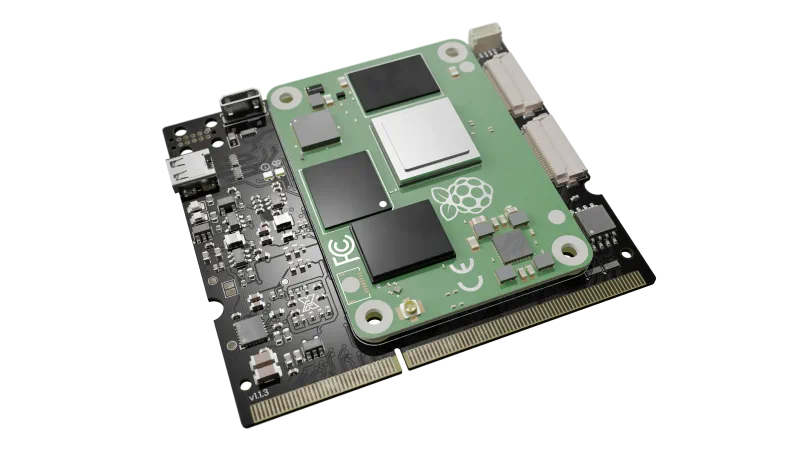
The xCore packs the brains of a robot into a single module. It pairs a real-time microcontroller with a full Linux computer, so you get tight, low-latency control and the horsepower to run high-level software — without wiring two separate boards together.
The idea
Robots need both worlds: a microcontroller for deterministic, real-time motor and sensor control, and a Linux SoC for navigation, mapping, and connectivity. The xCore puts both on one SODIMM-format card that drops into a carrier board via a standard connector — ready to fit into any custom project or robotics system.
Key specs
| Microcontroller | STM32H723 (real-time control) |
| Compute | Raspberry Pi Compute Module 4 (CM4) slot |
| Networking | Onboard Gigabit Ethernet switch |
| Sensing | Integrated IMU (inertial measurement unit) |
| Form factor | SODIMM module for easy integration |
Where it fits
The xCore is the compute core of OpenMower V2 and the Universal Logic Board, but it’s designed to be generic — any robot that needs real-time control alongside a Linux brain is a candidate.
Documentation, pinouts, and integration guides are maintained in the xCore documentation repository.
Constraints and architecture
A robot needs both real-time control and higher-level navigation and connectivity. The design places the STM32H723 and CM4 connection on a SODIMM-format module, with an IMU and Ethernet switch. This makes the carrier-board interface a central design boundary: the compute module and the device-specific connections can be considered separately.
Outcome and inspectable work
xCore is used as the compute core in the OpenMower V2 architecture and the Universal Logic Board described in this portfolio. The public documentation provides pinouts and integration guidance. These resources describe the design; application-specific timing, environmental, and reliability requirements still need validation in the target device.