Repeatable conditions for charger development
Testing a charger against a real battery means managing its starting charge and waiting for it to reach the state you want to investigate. A battery simulator provides a configurable electrical stand-in, so development can focus on the charger or power-management electronics.
I use this setup for battery simulation in my own testing. It combines a software battery model with programmable bench instruments. At a high level, the model tracks charge state while the instruments represent the battery at the device’s terminals. The test software coordinates the sequence and monitors voltage and current over time.
What the battery test interface shows
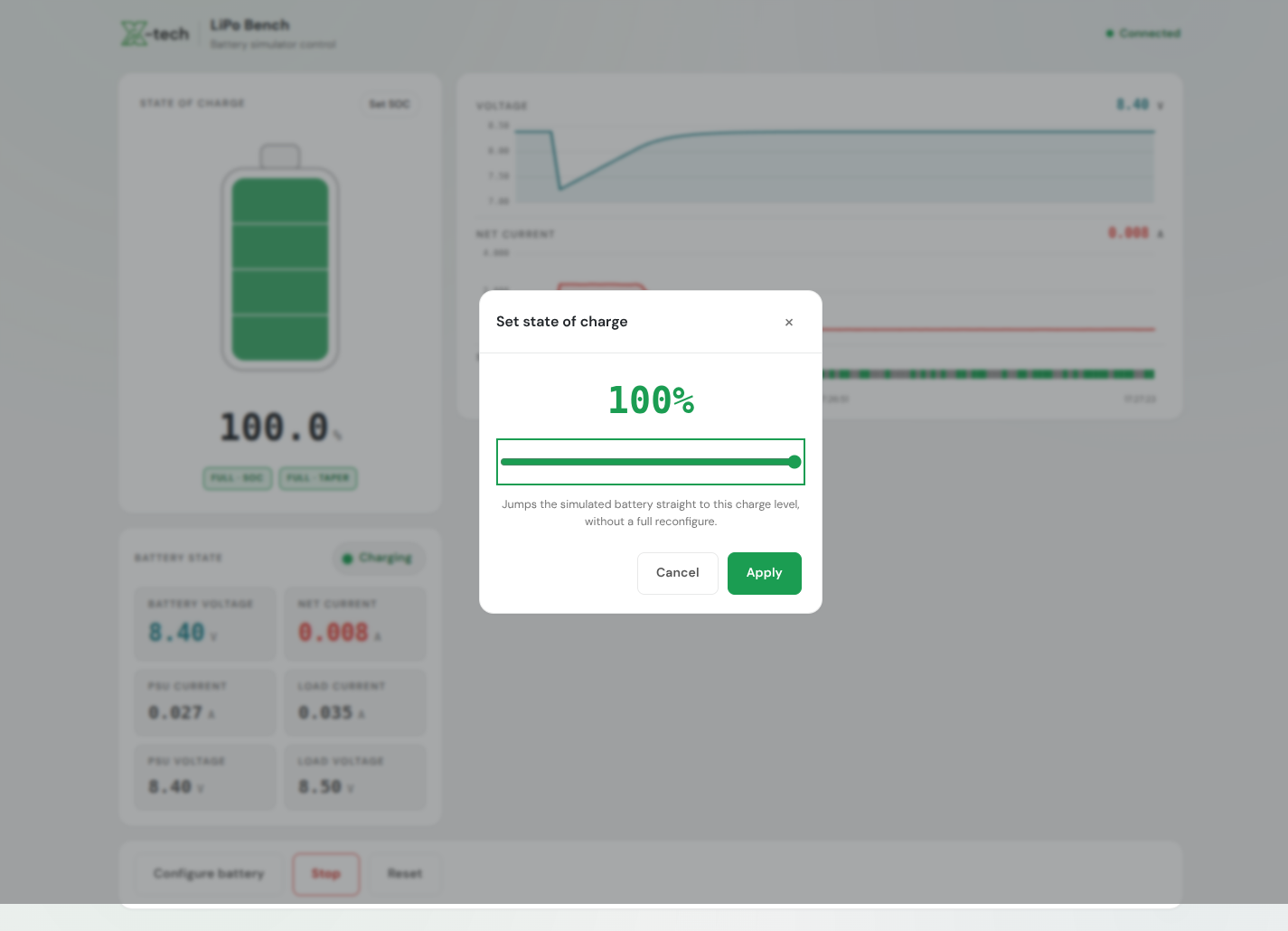
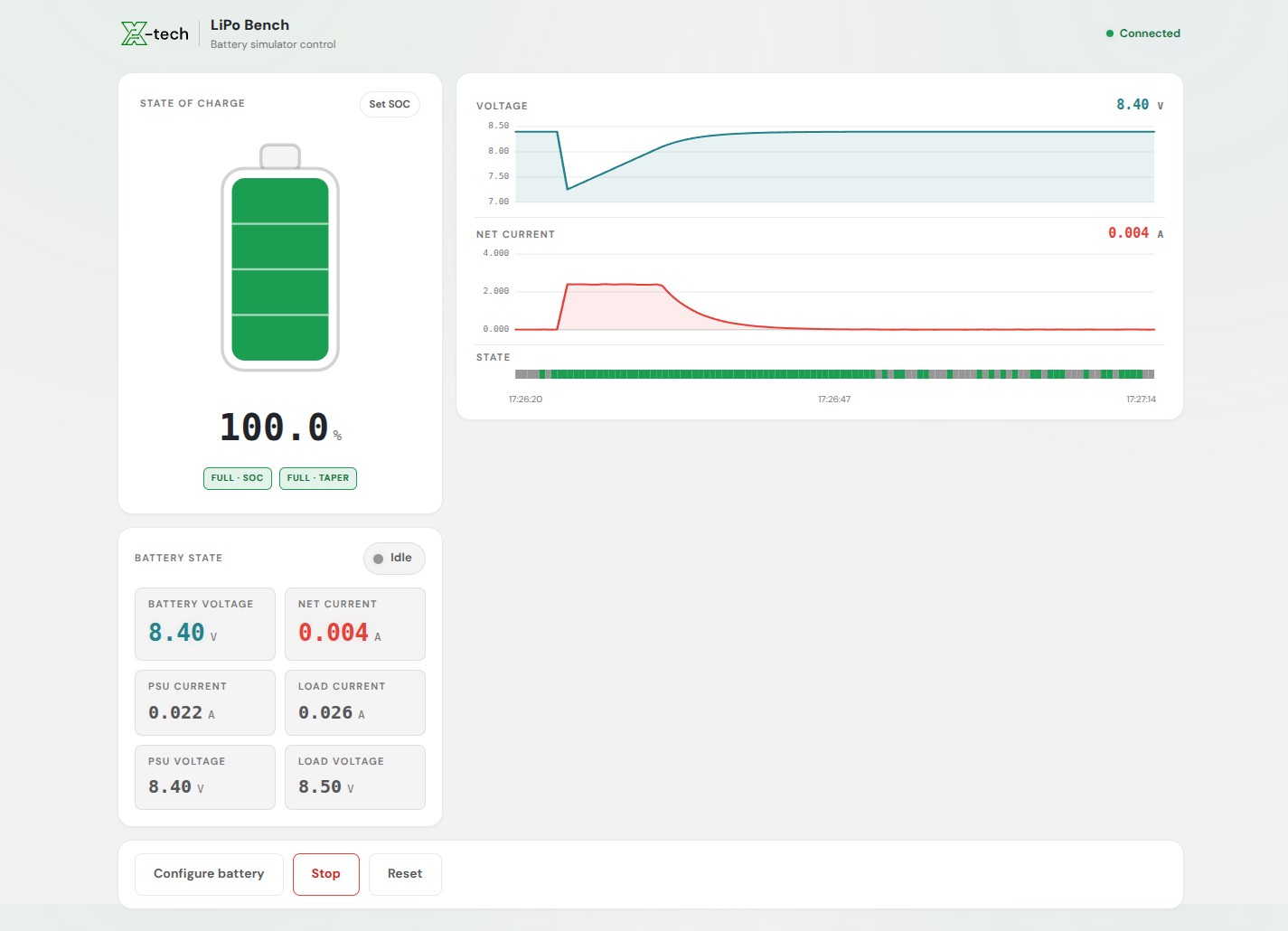
The dashboard brings state of charge, battery voltage, net current and instrument readouts into one view. Time-series plots make changes in voltage and charging current visible, with a state ribbon showing charging, discharging or idle conditions.
Battery parameters, initial charge state and current limits are configurable. The underlying simulator supports repeated runs and configurable end-of-charge detection. This provides a starting point for test sequences tailored to your charger and its expected behaviour.
Where a custom battery simulator helps
- Comparing firmware revisions from the same defined starting condition.
- Investigating charging transitions and end-of-charge behaviour.
- Exercising charger control logic without repeatedly preparing a physical battery.
- Bringing instrument control and operator feedback into a repeatable test workflow.
For production use, we agree the checks, acceptance criteria and result handling as part of the automated test setup.
A development tool, not a cell-certification claim
The current model is deliberately simplified. It does not reproduce every electrochemical, thermal or ageing effect of a real cell, and it does not replace validation with real batteries or required safety and compliance testing.
Discuss your charger or battery-test workflow
Tell me about the charging electronics, battery configuration, voltage and current range, and the behaviour you need to investigate. I can help scope a custom battery simulation setup, instrument automation or an operator interface for your test bench.